
In every workplace, communication can feel like a never-ending game of ping-pong. Messages fly back and forth – emails, meetings, quick Slacks- and sometimes it feels like no one’s actually catching what’s being sent. That’s because communication isn’t a straight line. It’s a living, breathing, ever-changing exchange.
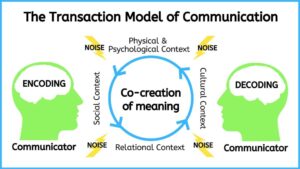
That’s the essence of the Transactional Model of Communication, first introduced by Dean Barnlund in 1970 and still one of the most accurate ways to describe how real people communicate today.
Communication Isn’t a Straight Line – It’s a Loop
Traditional models painted communication as something neat and tidy: one person sends, another receives. But the transactional model flips that idea on its head.
Here’s the short version:
We’re always sending and receiving—simultaneously.
Every conversation, meeting, or feedback session is a shared construction of meaning happening in real time. As one person talks, the other nods, reacts, interrupts, or disengages—and those cues change the message itself. Both people are influencing each other constantly.
That’s why the best leaders don’t just transmit information – they shape understanding together.
Why It Matters for Leaders
In leadership and HR, this model explains so much of what makes—or breaks—team communication.
Context rules everything.
Meaning doesn’t live in the words alone; it lives in the moment. Culture, timing, power dynamics, and even caffeine levels all shape how a message lands. The same sentence—“We need to talk”—can sound like a calm invitation or a career-ending warning depending on when and how it’s said.
Feedback is the engine.
Without feedback, communication becomes guesswork. Feedback—both cognitive (task-based) and affective (relationship-based)—turns one-way directives into shared understanding. It’s how you ensure the message you intended is the one that was received.
Noise is the invisible saboteur.
Every workplace has noise: burnout, assumptions, tech glitches, unclear priorities. Leaders who identify and reduce that noise create clarity and trust. Sometimes “naming the noise” (“I know there’s a lot going on today…”) is the most human way to reset communication before it derails.
So What Does It Look Like in Practice?
If you want to put the transactional model to work in your leadership, start here:
Frame before you fire. Before rolling out a new initiative or giving feedback, add one sentence of context: “Here’s why this matters right now.”
Mirror back meaning. Reflect what you heard before reacting: “So what I’m hearing is…” You’ll be shocked at how many misunderstandings dissolve right there.
Update the shared story. At the end of projects or even weeks, ask: “What’s our current reality?” It helps teams align on what’s changed and what hasn’t.
These small moves turn communication from chaos into connection.
Communication Is Who We Become – Together
The transactional model isn’t just an academic theory; it’s a mirror for how humans actually connect. Every email, every hallway conversation, every tough feedback moment is a chance to co-create meaning.
And here’s the truth: communication isn’t just what you do – it’s who your team becomes together.
If your organization is ready to strengthen those conversations – to turn feedback loops into fuel and context into clarity – let’s talk.
About AuthentiLead
At AuthentiLead, we help leaders move from chaos to clarity – transforming communication habits into organizational strength. Through interactive workshops, coaching, and Everything DiSC® tools, we help teams understand themselves and each other so they can build workplaces that actually work.
Because great communication doesn’t happen by accident – it happens by design.